

What if the most striking features of your Connecticut landscape are currently invisible for half the day? You've likely spent years meticulously nurturing your majestic Oaks or vibrant Maples, yet these natural sculptures often disappear into a dark void the moment the sun sets. It's common to feel that a dark yard lacks the security and aesthetic pride you've worked so hard to establish. Many homeowners hesitate to invest in uplighting trees and shrubs because they worry about creating harsh "hot spots" or blinding glare that disrupts the tranquility of the neighborhood.
We understand that a well-cared-for property is an essential component of a high-quality lifestyle. This guide will show you how professional lighting techniques can transform your home into a multi-dimensional nighttime masterpiece. You'll discover how to select the perfect fixtures for specific growth patterns, ensure your system remains energy-efficient, and create a sophisticated atmosphere that enhances both safety and curb appeal. We'll provide a clear path to achieving a durable, elegant design that serves as a bridge between your interior comfort and the hidden potential of your outdoor space.
Key Takeaways
- Distinguish between canopy lighting for broad branches and grazing techniques that reveal the intricate textures of specimen bark.
- Master the balance of shadows and highlights when uplighting trees and shrubs to create a sophisticated, multi-dimensional environment.
- Understand how foundation plantings ground your landscape design and bridge the visual gap between the lawn and the high canopy.
- Explore why low-voltage LED systems are the industry standard for Connecticut properties, offering safety, efficiency, and durability through harsh winters.
- Discover how a craftsman-led design process tailors lighting to the unique wooded topography found in Simsbury and Glastonbury.
The Art of Uplighting: Beyond Simple Spotlights
Professional landscape design isn't about flooding a yard with light. It's about intentionality. Uplighting is the strategic placement of fixtures at the base of a feature to direct light upward, revealing what the day hides. When uplighting trees and shrubs, we aim to create a "Three-Dimensional Experience." This technique adds depth and texture, turning a flat, dark yard into a layered masterpiece. Landscape lighting serves as the foundation for this transformation, allowing us to establish focal points that draw the eye through the property.
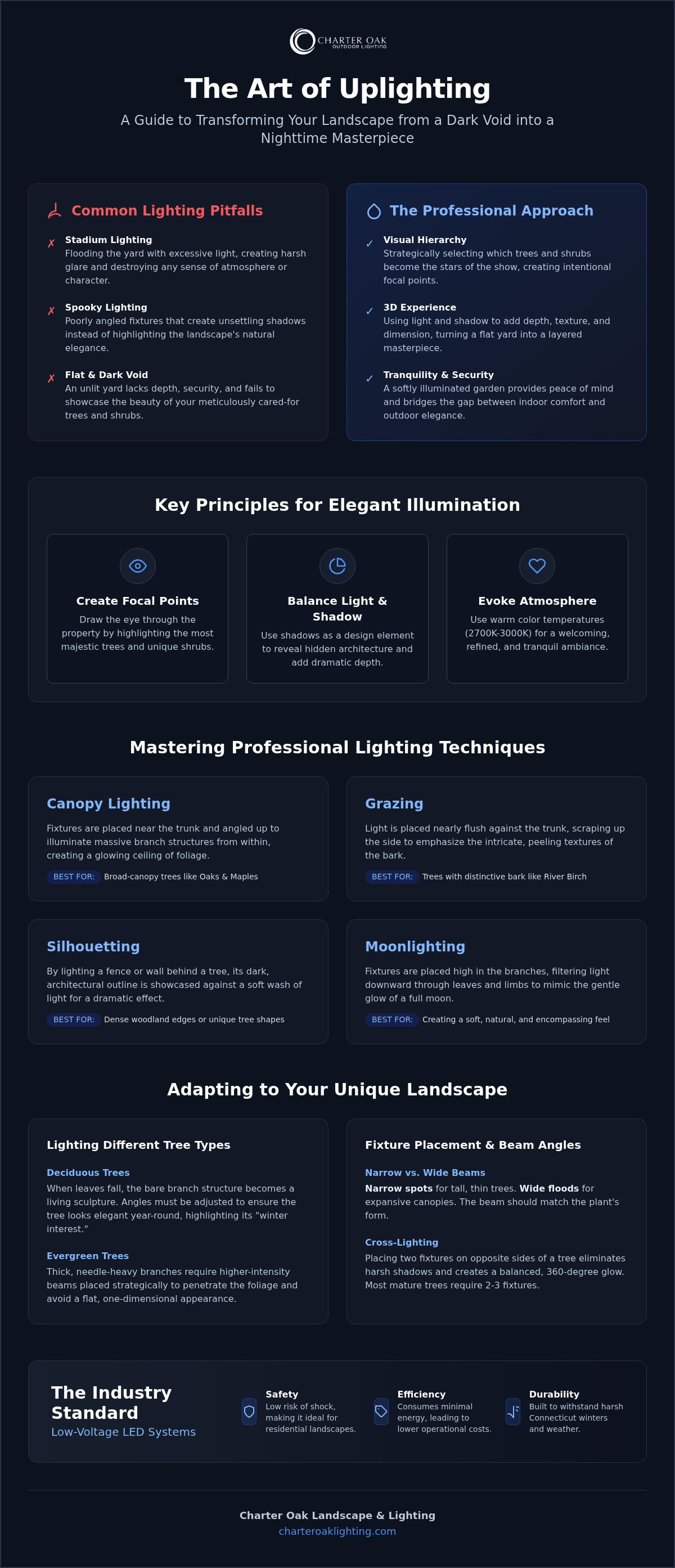
Not every plant needs a spotlight. We use "Visual Hierarchy" to decide which specimens should be the stars of the show. A common mistake is "stadium lighting," where the property is so bright it loses all character. Conversely, "spooky lighting" occurs when fixtures are poorly angled, creating unsettling shadows rather than elegance. Meticulous placement ensures that shadows work for you, not against you, revealing the hidden architecture of nature through strategic highlights.
Why Uplighting is Essential for Connecticut Curb Appeal
In towns like Avon and Simsbury, the majestic structure of native New England trees defines the local character. Uplighting is an architectural tool for nature, designed to reveal the hidden structure of the landscape after dark. By highlighting the reaching branches of a century-old Oak or the delicate spread of a Dogwood, we extend the usability of your outdoor living spaces. This approach ensures your property remains a source of aesthetic pride long after the sun sets, enhancing the existing features of your home with professional care.
The Emotional Impact of a Well-Lit Landscape
A well-lit exterior does more than look good; it provides a sense of tranquility and security. There’s a unique comfort in looking through a window and seeing a softly illuminated garden rather than a black void. When uplighting trees and shrubs, this transition from interior comfort to an elegant exterior view bridges the gap between your home and the natural world. By utilizing warm color temperatures, specifically between 2700K and 3000K, we evoke a welcoming atmosphere that feels both refined and grounded. It's a sophisticated way to enhance your property's nighttime identity while providing lasting peace of mind.
Mastering Techniques for Different Tree Architectures
Mastering the art of uplighting trees and shrubs requires a deep understanding of botanical form. Different species demand specific approaches to reveal their best nighttime character. For broad-canopy giants like Maples and Oaks, we utilize canopy lighting. This involves placing fixtures closer to the trunk and angling them upward to illuminate the massive branch structures from within. It creates a glowing ceiling of foliage that feels both protective and majestic.
For trees with distinctive bark, such as River Birches or Shagbark Hickories, we use a technique called grazing. By placing the light source nearly flush against the trunk, we emphasize the intricate textures and peeling layers that define these specimens. If your property features a dense woodland edge, silhouetting can provide a dramatic backdrop. By lighting a fence or wall behind a tree, we showcase its dark, architectural outline against a soft wash of light. For a truly natural look, moonlighting is a pro-tip where we place fixtures high in the branches to filter light downward, mimicking the gentle glow of a full moon.
Lighting Deciduous vs. Evergreen Trees
Connecticut landscapes often feature a mix of dense evergreens and stately deciduous trees, each presenting unique challenges. Evergreens like Pines and Spruces have thick, needle-heavy branches that light won't easily penetrate. To avoid a flat appearance, we use higher-intensity beams tucked slightly into the outer foliage. For deciduous trees, we must account for winter interest. When leaves fall, the bare branch structure becomes a living sculpture; adjusting the angle of your fixtures ensures the tree looks elegant in January as it does in June. Mature trees with wide spreads usually require two or three fixtures to achieve a balanced, 360-degree glow.
Fixture Placement and Beam Angles
The choice between a narrow spot beam and a wide flood beam depends entirely on the tree's height and width. Tall, thin specimens like Italian Cypresses or younger Birches need narrow beams to reach the top without spilling light into the sky. Conversely, expansive canopies require wide flood beams to cover the full breadth of the foliage. We often employ "Cross-Lighting," placing two fixtures on opposite sides of the tree. This eliminates harsh shadows and ensures the feature looks beautiful from every viewing angle, including from inside your home. Following expert methods for uplighting a tree helps avoid the common mistake of "one-sided" lighting. If you're curious about how to improve curb appeal with lighting, focusing on these architectural nuances is the first step toward a professional result.
Strategic Uplighting for Shrubs and Foundation Plantings
While majestic trees often command the most attention, neglecting the mid-level greenery can leave your property feeling disconnected. Shrubs play a vital role in grounding your landscape design. They act as the visual anchor that prevents your home from appearing as if it's floating in a dark void. By mastering the art of uplighting trees and shrubs, you create a seamless transition from the manicured lawn to the towering canopy above. This layering technique adds necessary depth, ensuring the middle ground of your garden is just as captivating as the focal points.
To achieve a natural look for lower-level plantings, we often employ wash lighting. This technique involves a wider, softer beam that bathes a hedge or a row of Boxwoods in a gentle glow. It's essential to avoid "hot spots" on smaller plantings. Because shrubs are closer to the eye and the ground, we utilize lower-lumen outputs to prevent the light from becoming overbearing. This meticulous approach ensures the texture of the foliage is revealed without being washed out by excessive brightness. It's a subtle balance that requires a craftsman's eye.
Enhancing the Architecture of Your Home
Strategic lighting for foundation plantings does more than highlight greenery; it emphasizes the soul of your home's architecture. By uplighting shrubs near the foundation, we can cast soft light against stone or siding, revealing the intricate textures of the building materials. This creates a soft transition between the organic garden and the home’s facade. We carefully select the light intensity to ensure it doesn't bleed into windows. This preserves your view of the illuminated exterior from the inside, maintaining that essential bridge between interior comfort and exterior elegance.
Seasonal Interest in Shrub Lighting
In West Hartford and surrounding areas, the landscape changes dramatically with the seasons. Uplighting transforms snow-covered shrubs into glowing sculptures during the winter months, providing a sense of warmth during the coldest nights. Beyond aesthetics, shrub illumination plays a practical role by maintaining visibility and safety along walkways. Low-voltage LED systems allow us to add these subtle shrub accents with precision and energy efficiency. This ensures your property remains a sophisticated masterpiece throughout every Connecticut season, reflecting a commitment to both beauty and utility.
Technical Essentials: Low-Voltage LED and Smart Placement
The technical foundation of a lighting system determines whether your investment lasts for a season or a generation. When uplighting trees and shrubs, we exclusively utilize low-voltage (12V) systems. This industry standard offers unparalleled safety for families and pets, as the current is significantly lower than standard household outlets. Flexibility is another key benefit; low-voltage wires don't require the deep, disruptive trenching associated with line-voltage systems. This allows us to weave cables around delicate root systems with minimal impact on your established landscape.
Durability is a non-negotiable requirement in the Northeast. Connecticut winters bring heavy snow, ice, and salt, which can quickly degrade inferior materials. We prioritize professional-grade brass or copper fixtures that withstand these harsh conditions. Unlike plastic or thin aluminum alternatives, these metals develop a beautiful natural patina over time and remain structurally sound through decades of freeze-thaw cycles. To refine the visual output, we incorporate glare control accessories like shrouds and hex louvers. These components ensure the light remains focused on the foliage, preventing stray beams from hitting your eyes or your neighbor's windows.
Energy Efficiency and System Longevity
The shift to LED technology has revolutionized how we illuminate properties in Farmington and the surrounding areas. Quality LED fixtures use approximately 75% to 80% less energy than traditional halogen bulbs, providing a stunning visual impact with minimal effect on your monthly utility bill. Beyond energy savings, the longevity of these systems is remarkable. While traditional halogens often burn out within a few thousand hours, professional-grade LEDs are rated for 50,000 hours or more. This equates to nearly 20 years of nightly use. Investing in an energy efficient outdoor lighting installation ensures you spend less time on bulb replacements and more time enjoying your property. We use weather-sealed connections and high-capacity transformers to protect the system's delicate electronics from moisture and power surges.
Smart Controls and Automation
Modern systems offer "set it and forget it" convenience through integrated smart controls. We often install photocells and digital timers that automatically adjust to the changing sunset times throughout the year. For homeowners who desire more control, zoning allows you to dim certain areas for a quiet evening or brighten them for a gathering. This level of customization ensures your landscape's nighttime identity is always perfectly tuned to the occasion. To keep these components performing at their peak, it's vital to prioritize ongoing maintenance. If you're ready to secure your property's future, contact us for a professional system evaluation.
Designing Your Connecticut Landscape’s Nighttime Identity
Every residential property in Hartford County possesses a distinct character, particularly those nestled within the rolling, wooded topography of Simsbury and Glastonbury. At Charter Oak Outdoor Lighting, our meticulous, craftsman-led design process ensures your home’s unique story is told with clarity and grace after dark. Uplighting trees and shrubs is far more than a mere technical installation; it's a visionary artistic endeavor to reveal the hidden architecture of your specific environment. We view each project as a way to extend the comfort of your home beyond its physical walls, creating a seamless flow between your living room and the natural world outside. We don't believe in generic, one-size-fits-all solutions that ignore the natural contours of your land. Instead, we focus on creating a tailored nighttime identity that reflects your lifestyle while elevating the inherent elegance of your outdoor space.
From Vision to Installation
Our process moves methodically from vision to reality. We begin by walking your property during a professional consultation to identify the "anchor" specimens that will serve as the foundation of your lighting portrait. This phase is critical for creating a cohesive look that balances striking curb appeal with the intimate privacy required for your backyard retreats. Whether we're highlighting a specimen feature or creating a soft wash along a wooded perimeter, our custom plans consider every viewing angle, including the vistas from your interior windows. Once the design is finalized, Charter Oak Outdoor Lighting follows through with a clean, non-disruptive installation process. We treat your grounds with the same care you do, ensuring your landscape remains pristine throughout the transition.
Partnering with a Local Specialist
Partnering with an owner-operated business based in Farmington, CT, provides the reassurance of local expertise and personal accountability. Charter Oak Outdoor Lighting values the long-term relationship over a simple transaction, framing our work as an enduring commitment to your property’s excellence. This ongoing dedication ensures that as your trees grow and your landscape matures, the lighting evolves with it, maintaining the artistic integrity of the original design. This partnership naturally includes providing professional outdoor lighting maintenance to safeguard your investment against the New England elements. A professional design is the essential first step toward achieving a lifetime of nighttime elegance and peace of mind. If you're ready to transform your Connecticut property into a multi-dimensional masterpiece, Schedule your custom landscape lighting consultation with Charter Oak Outdoor Lighting today.
Illuminate Your Property’s Hidden Potential
Professional lighting design transforms a dark landscape into a sophisticated sanctuary. You now understand how strategic techniques like canopy lighting and grazing reveal the textures of your favorite specimens while avoiding the common pitfalls of glare or "hot spots." By mastering the art of uplighting trees and shrubs, you transform your property into a multi-dimensional masterpiece that remains both sustainable and stunning through every Connecticut season.
As an owner-operated local specialist, Charter Oak Outdoor Lighting is dedicated to meticulous craftsmanship that reflects the unique character of your home. We proudly serve homeowners in Farmington, Avon, and West Hartford, providing the technical expertise required for high-efficiency, low-voltage systems. It's time to move beyond simple illumination and create a nighttime identity that provides lasting peace of mind. Every great landscape deserves to be seen, even after the sun sets.
Are you ready to see your environment in a new light? Request a Custom Lighting Design Consultation today and let us bring your vision to life.
Frequently Asked Questions
What are the best trees to uplight in a Connecticut landscape?
Stately deciduous trees like White Oaks and Sugar Maples are exceptional candidates for uplighting due to their expansive branch architecture. In towns like Simsbury and Avon, we often focus on specimen trees with unique bark, such as River Birches or Shagbark Hickories. These species provide year-round interest, offering a dramatic skeleton in winter and a lush canopy in summer. Evergreens like Spruces also work well but require specialized placement to penetrate their dense needles.
How many lights do I need for a large Oak or Maple tree?
A mature Oak or Maple typically requires two to three fixtures to achieve a balanced, three-dimensional look. Using a single light often creates a flat appearance and harsh shadows on the opposite side of the trunk. By placing multiple low-voltage fixtures around the base, we ensure the tree looks elegant from every angle, whether you're viewing it from the street in West Hartford or from your back patio. This layering creates depth and essential visual interest.
Will uplighting trees disturb my neighbors?
Professional design ensures that light stays focused on your landscape rather than spilling into a neighbor's window. We utilize fixtures with integrated shrouds and hex louvers to eliminate glare and light pollution. By carefully calculating beam angles and placement, we highlight your property's beauty while maintaining the tranquility of the neighborhood. This meticulous approach is especially important in the closely-knit residential communities of Farmington and Glastonbury, where we prioritize the bridge between beauty and neighborhood utility.
Is LED uplighting expensive to run every night?
LED technology is remarkably cost-effective, using approximately 75% to 80% less energy than traditional halogen bulbs. Running a standard residential system every night typically adds only a small amount to your monthly utility bill. Because these high-efficiency systems consume so little power, you can enjoy a beautifully illuminated exterior without worrying about significant operational costs. It's a sustainable way to enhance your home's nighttime identity while keeping Farmington energy bills manageable and predictable for years to come.
Can I uplight shrubs during the winter months?
Winter is actually one of the most rewarding times for uplighting trees and shrubs in Connecticut. When snow blankets your garden, uplights transform ordinary shrubs into glowing, ethereal sculptures. This technique also provides essential visibility and safety during the long, dark nights of a New England winter. Our professional-grade brass and copper fixtures are specifically designed to withstand freezing temperatures and moisture, ensuring your system remains reliable through the harshest West Hartford storms and heavy ice.
What is the difference between a spotlight and a floodlight for trees?
The primary difference lies in the beam angle. Spotlights produce a narrow, concentrated beam of light, making them ideal for tall, thin trunks or reaching the high canopy of a mature Oak. Floodlights offer a much wider spread, which is perfect for washing a broad row of shrubs or a dense hedge in soft light. Choosing the right fixture depends on the specific architecture of the plant and the desired visual effect for your Connecticut landscape design.
How far from the trunk should an uplight be placed?
Placement depends on the specific design goal. For a grazing effect that highlights bark texture, we place the fixture within 6 to 12 inches of the trunk. If the goal is to illuminate the broad canopy of a Maple, we typically move the light 2 to 4 feet away from the base to allow the beam to spread properly. Finding the perfect distance requires an understanding of the tree's growth pattern and the fixture's specific beam spread capability.
Do I need a professional to install tree uplighting?
A professional ensures your system is safe, durable, and aesthetically superior. As an owner-operated specialist in Farmington, we understand the nuances of uplighting trees and shrubs, including voltage drop and artistic placement. Professional installation avoids common mistakes like hot spots or exposed wires that can be damaged during lawn care. We provide a meticulous process that protects your investment and ensures your property remains a multi-dimensional masterpiece, giving you peace of mind and long-term reliability.


